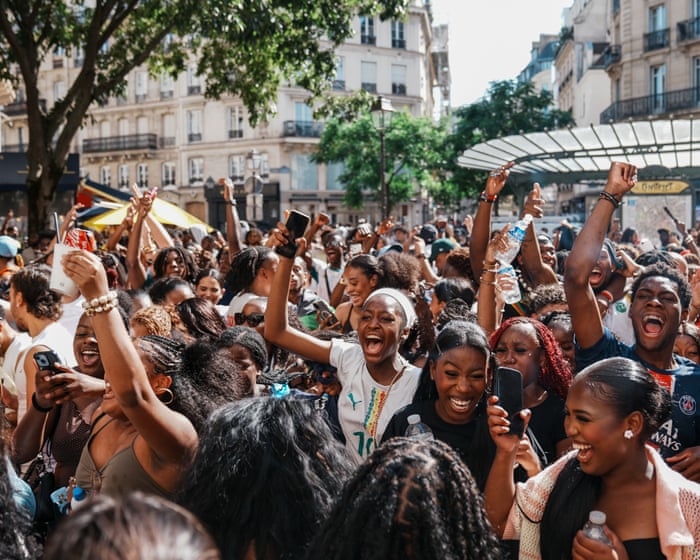
‘It’s giving me carnival vibes’: how Fête de la Musique became a must-visit event for the Black diaspora
Begun in 1982, the festival is now a magnet for Black Britons, who spill across Paris enjoying genres from amapiano to zouk. But can it resist commercialisation – and is it getting too big?
At 4.45pm in Châtelet, central Paris, a man leans out of his third-floor balcony, blasting EDM from his speakers. A makeshift cardboard sign is strapped to his decks, detailing his Instagram account in capital letters. On both sides of him, his friends hype him up from opened windows, and on the ground a crowd has started to gather. Completely spontaneous, slightly ridiculous and entirely alive, this is typical of Fête de la Musique.
Born in 1982 as a free, France-wide, government-sanctioned initiative to encourage citizens to pick up instruments and play for their neighbours, the Fête has long since outgrown its origins. Word of mouth, TikTok and the growing allure of French language music have propelled it to heights no arts ministry could have planned for, and Black Francophone culture has become the heartbeat of the weekend. Bouyon, shatta, zouk, French Afrobeats, trap, hip-hop and R&B are the sounds that have travelled farthest, enticing fresh crowds of Brits, predominantly Black, to Paris every June.
Continue reading...
Jun 24, 2026
Music
Pop and rock
Dance music